
Lead Institution: University of Bath
Collaborating with: Science Learning Centre South West / Institute of Physics, University of Bristol, University College London
The project team evaluated the experiences of students in STEM communication activities, assessing their perceptions prior to taking part in a STEM communications event versus their reflection on the experience following the event. The team were interested in how perceptions and experiences might vary across the three STEM communicator models - i.e. if students were volunteers, paid or undertaking STEM activities as an accredited part of their degree. To gather data, two electronic surveys were sent out to students both before and after activities and interviews were conducted with students.
A powerpoint summary and a copy of the Research Results can be accessed at the bottom of the page.
The questionnaires and interview schedule used during the course of the project can be downloaded below:
The word clouds below represent the respondents’ emotions both before and after being involved in the STEM communication activities. The larger the word the more respondents selected that option. (Note that the word colours and orientations do not have any particular meaning).
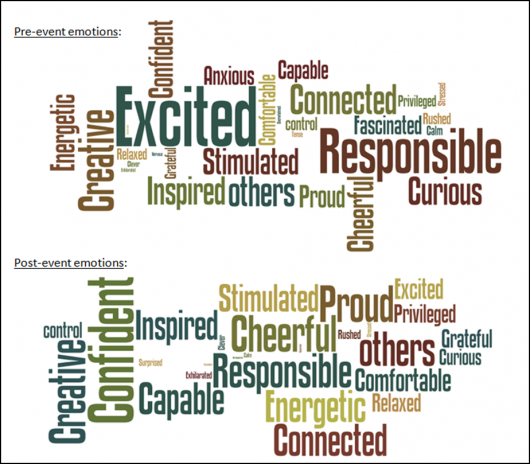
Word clouds representing respondents' emotions

Professor Chris Budd
Project lead, University of Bath

Dr Alison Rivett
Science Learning Centre South West / Institute of Physics

Dr Helen Heath
University of Bristol

Dr Karen Bultitude
University College London

 Community of Practice for Outreach and WP Practitioners
 The Hydrographic Academy: Meeting the needs of the workforce and industry through innovative, flexible, online distance learning
 Technology-enabled employer engagement in analytical chemistry
 Student-led Employability Audit Toolkit
 Transition & Induction Experiences of WP Students
 Get STEM working: innovation with employer and student engagement
 The challenges and opportunities of incorporating community-based learning into STEM subjects
 Strengthening, extending and embedding employer engagement
 Projects without borders: Understanding how employer-led UG projects differ across the STEM disciplines
 Progressing from labour market intelligence to HE level provision that is well supported by employers
 Adult returner journeys through HE to STEM careers
 Developing & Enhancing STEM Communicator Models
 Peer Assisted Learning & STEM
 The integration of understanding of offerings for engagement between universities and industry
 A study of the key drivers in workforce engagement with HE level provision in the Aerospace sector
 Development and implementation of a programme of employability skills for Science undergraduates
 Enhancing Workplace Statistical Literacy
 Visual Impairment & STEM
 Enhancing STEM Academics' Public Engagement Skills
 Employer engagement continuum model
 Learning chemistry through placements: building on good practice and identifying new opportunities
 Becoming a STEM Enthusiast - Outreach & CPD Video Resources
 Promoting employer engagement opportunities to employers
 Employability Skills of STEM Student Ambassadors
 Extending the Use of Spectroscopy in a Suitcase


© University of Bath 2011-12
HE STEM Programme, University of Bath, Bath, BA2 7AY, UK
Updated by HE STEM web team
Website by Float
